
After many years of no contact, Willis Eschenbach of the “steel greenhouse” fame responded to a recent comment of mine today on Facebook where I reminded him that his explanation of how the radiative greenhouse effect of climate science works requires a violation of the First Law of Thermodynamics (or the Law of Conservation of Energy).
If you may recall, Willis is what we have identified as a gatekeeper who pretends to be a skeptic while in fact defending the basis of climate alarm theory, which is climate science’s version of a greenhouse effect which functions with thermal radiation. A real greenhouse works by stopping convective cooling because it traps air in place to be heated to the full potential of sunlight, which is upwards of eighty or ninety degrees Celsius (176F to 194F) at the surface of the Earth, whereas air in the open is free to convect and to rise away after it has been warmed by the surface, which thereby keeps the air near the surface cooler. The radiative greenhouse effect of climate science is a false analogy to the convective greenhouse effect, where trapping radiation is claimed to cause warming inside the trap in analogy to how air trapped inside a real greenhouse warms due to prevention of convection.
The typical presentation of climate science’s radiative greenhouse effect is with the flat Earth diagrams, such as those below, where one must debunk them based upon the somewhat technical jargon of the definition of heat and “heat flow”, making the point that it is impossible for heat to flow in reverse, or backwards, from cold to hot, given that the atmosphere is cooler than the surface. The philosophical or logical score is that, in ultimate simplification, these diagrams supposedly showing how the radiative greenhouse effect of climate science works are quite literally nothing more than the development of flat Earth theory into false pseudophysics, given that they geometrically depict the Earth as a whole as a flat object, thus reducing climate alarmism to nothing more than the absurdity of flat Earth theory.
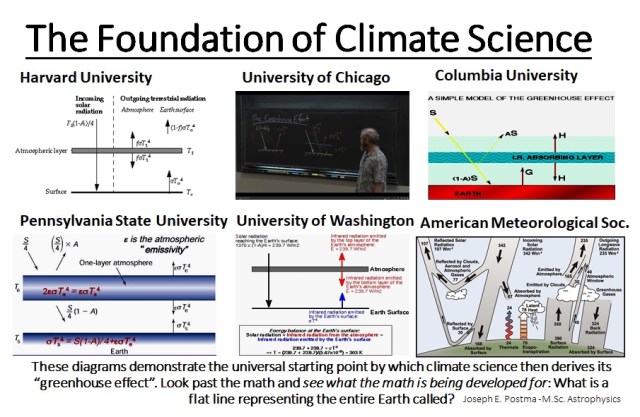
With the flat-Earth derivations it is not possible to reduce or expose the error to something so simple and obvious as a violation of the Law of Conservation of Energy, because the areas of the surface and of the atmosphere are the same in such diagrams. However, Willis recast these derivations into a spherical model, which I in fact did not at first realize just how much more obvious, and simple, they make of the exposure of the underlying error. It is one thing to debate heat equations and the fact that heat can only act from hot to cold, but it is much more obvious to find that energy in is not equal to energy out, i.e., that one is not equal to two, and that is what Willis did for us.
Willis begins with a sphere producing its own internal energy, such that it produces 235 W/m2 from its surface. He then places a shell about the sphere, and suggests a result as depicted in his second diagram below, explained following.
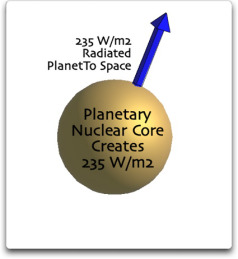
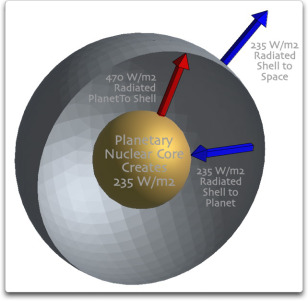
WE: “Now, note what happens when we add a shell around the planet. The shell warms up and it begins to radiate as well … but it radiates the same amount inwards and outwards. The inwards radiation warms the surface of the planet, until it is radiating at 470 W/m2. At that point the system is back in equilibrium. The planet is receiving 235 W/m2 from the interior, plus 235 W/m2 from the shell, and it is radiating the total amount, 470 W/m2. The shell is receiving 470 W/m2 from the planet, and it is radiating the same amount, half inwards back to the planet and half outwards to outer space. Note also that despite the fact that the planetary surface ends up much warmer (radiating 470 W/m2), energy is conserved. The same 235 W/m2 of energy is emitted to space as in Figure 1.”
Willis claims that his scheme conserves energy, but we can prove that he is either incompetent, or lying, and in fact he has provided us the simplest and most clear-cut method of debunking the radiative greenhouse effect of climate alarm science. The mechanics of the radiative greenhouse effect of the flat Earth diagrams above, if they represent general principles of physics, should of course translate directly into a derivation with spheres, and this is why Willis presents it this way such as to make it more relatable to the sphere of the Earth. That is, if the radiative greenhouse effect of climate science is real, then it has to produce the result which Willis extrapolated the sphere and shell, because the mechanism is exactly the same as with the flat lines.
Thus: What is the statement of the Law of Conservation of Energy? Of course, it is that energy is conserved, that we cannot lose or gain any energy without it being explained. And so with Willis’ sphere which is producing energy, which we’ll call the input energy (Ein), this has to be equal to the energy which comes out or goes out to space (Eout).
Ein = Eout
Note that Willis explains that 235 W/m2 is being produced by the sphere, and then claims that this is conserved by 235 W/m2 going out from the shell. What’s the problem? The problem is that the units of those values are fluxes (W/m2), whereas the Law of Conservation of energy applies to flux (F) times surface area (A)!
E = F*A
The surface area of the shell is larger than that of the sphere, and therefore, the shell is emitting more energy than the sphere provides! From the diagram, we can estimate that the shell area is, say, two-times larger than the sphere area, and since F is the same in Willis’ diagram for both input and output, then
Ein = F * Asphere
and
Eout = 2 * F * Asphere
Willis, therefore, is either unaware, or is falsely claiming and trying to lie to his readers, that the units he is using are Watts per meter square (W/m2), and that these are what the Law of Conservation of Energy conserves! When he does that, it results in:
Ein = 2 * Ein
but Willis hides this result by using the numeric value of 235, hoping that his readers do not realize what W/m2 mean.
To re-explain, conservation of energy applies to energy, and energy is flux times area (A), and therefore
Ein = 235 W/m2 * Asphere
Eout = 235 W/m2 * Ashell
Since Ashell > Asphere, then Eout > Ein, and thus, energy is NOT conserved.
What Willis actually proves to us is that the radiative greenhouse effect can only be true if we allow a violation of the First Law of Thermodynamics, of Conservation of Energy. This is an excellent and simple result that cuts through and rides right over all of the papers written about heat equations and the definition of heat, etc. The steel greenhouse proves that climate science’s greenhouse effect can only work if we dispense with conservation of energy.
And you know what? Many, many years ago, I contacted Willis about this error, and do you know what his answer was at that time? He said that we can “treat the violation of energy as negligible”, and therefore it is OK! I tried following up with objection to this claim, but he wouldn’t respond. In effect, Willis claims that the Law of Conservation of Energy is
Ein = Eout ± δ
where δ is a term which allows for “negligible” difference from perfect equality. In Willis’ mind, the first law can be violated by some non-zero amount, “δ”; the law of conservation of energy is not a perfect equality, but an equality with some fuzzy space on the sides so that we can get around the first law when we need to believe in the radiative greenhouse effect! I would like to know: How large can δ be before the law of conservation of energy is violated?
Let’s take the Earth, and its radius of r = 6,378,000 meters, and then the atmosphere adding another 10km (10,000 meters) on top of that.
Then we have
Ein = 235 * 4πr² = 120,128,694,142,793,499.76752183601049 W
Eout = 235 * 4π(r + 10,000)² = 120,505,686,517,861,336.39205464860154 W
which is a difference of 376,992,375,067,836.62453281259104766 W, or about 376 trillion Watts!
So for Willis, we have to believe that the law of conservation of energy can be violated by 376 trillion Watts, that 376 trillion is “negligible”!
So, how much larger can we go beyond an inequality of 376 trillion Watts, or even as a percentage ratio, before we reach the threshold of violating the law of conservation of energy? Every scientist, engineer, and mathematician in the world would like to know the answer to this, Willis!
In the end, we really must thank Willis for this most-deft and simple debunk of the radiative greenhouse effect of climate science.
 Climate of Sophistry
Joe – Brilliant.
Here is another person who needs correcting.
Global Warming I: The Science and Modeling of Climate Change
From the transcript:
Wibbly wobbly, Timey wimey
Astonishing he clearly has no idea that solids transmit shear waves and it shear wave coupling that creates a blackbody emitter.
I have been arguing with Richard Green on this very point, so this article is right on cue. I reject the term greenhouse effect completely, a blanket effect is a better term and as far as I can establish its clouds not CO2. No connection of CO2 and water should be allowed as its the net zero policy that destroys our civilisation.
@brinsleyjenkins
This is a superb example of the power of sophistry.
They hide in plain sight a lie which it takes years for me to notice.
Thanks Joe.
Thanks its been a long battle and I had no idea of why he was so critical of changing to blanket effect.
I’m embarrassed WE here. That’s just an argumentative spanking.
You can redo this math, without allowing violations of conservation of energy like Willis does, with view factors.
The sphere generates energy Ein, so by conservation of energy the shell must emit energy Ein, or a flux Fshell = Ein / Ashell.
The shell emits this same flux inward, but not all of it goes to the sphere. The view factor can be calculated from reciprocity. V(sphere to shell)Asphere = V(shell to sphere)Ashell . And V(sphere to shell) =1 clearly. So V(shell to sphere) = Asphere / Ashell .
Then the power from the shell to the sphere is Fshell * Ashell * V(shell to sphere) = Ein * Asphere / Ashell.
Finally by conservation of energy, the sphere must emit a flux Fsphere = (Ein / Asphere) (1 + Asphere / Ashell).
Yes if you backtrack the link I’ve worked out all the math for this scenario previously.
Generation is merely conversion of energy.
Where is the energy of the sphere coming from?
Willis imagines it’s from some or any source, which is fine. Say nuclear decay.
This is excellent-aside…you should all watch this, it’s a good chat…long but lots of good discussions
Joe,
It’s been a while since I last commented on your site and, at the time that I did, I was a committed non-believer in the concept of ‘back radiation’. However, I now see where we (back-radiation deniers) have been getting it wrong. For far too long I’ve held back and not shared what I now know to be true: Willis Eschenbach’s conclusions to his “steel greenhouse” thought-experiment are actually correct.
For many, many, months I, too, struggled with steel greenhouse thought experiment: How could something that contributed no additional power (the shell), increase the temperature of the sphere? Surely, that would require additional energy – and yet the shell provides no additional energy. However, what is being overlooked, by those that continue to struggle with that thought experiment, is the effect of Time: Specifically, during that period when the sphere continues to radiate it’s own source power (towards the shell) whilst the surrounding shell is not radiating this same amount source power out into free space. During this time, the sphere and shell have not reached their respective ‘steady state’ temperatures. During this time, additional energy is being built-up (and retained) within the system.
To help, I’m going to offer an analogy. I know that many dislike analogies, but this one is good, so please bear with me and let the (necessarily long) story unfold….
A person has been raised to believe that they should give away 10% of their wealth (which is represented by the funds held in their checking account) to an external charity, each month.
On the first day of the first month, when this person starts their first paid job (say at a monthly rate of $1000), they have zero dollars in their checking account, so they give away nothing to charity. At the end of “month one”, they receive their first $1000 salary paid into their checking account.
At the commencement of “month two”, they now have $1000 in their checking account and so give away a $100 check to charity. At the end of “month two”, they again receive their $1000 salary paid into their checking account.
At the commencement of “month three” they now have $1900 in their checking account and so give away a $190 check to charity. At the end of “month three”, they again receive their $1000 salary paid into their checking account.
At the commencement of “month four” they now have $2710 in their checking account and so give away a $271 check to charity. At the end of “month four”, they again receive their $1000 salary paid into their checking account.
You will see that eventually their checking account will reach $10,000 and they will give away $1,000 each month to charity, and they will earn $1,000 for the next month – the state of financial equilibrium has been reached.
Many years pass and this hardworking and generous person rears a child and this child is also raised with a very charitable nature. However, unlike their hardworking parent, this child (now entering adulthood) does not become an independent worker in their own right but instead, remains wholly dependent upon their generous parent for their entire income. The parent, believing that “charity begins at home”, continues to give 10% of their wealth away but now, all of their charitable giving goes to their dependent child, rather than the external charity.
On the first day of the first month (donation day), when the dependent child leaves home, the dependent child has no wealth in their own checking account and so gives no charitable donation to any external recipient and similarly gives no charitable donation to their hard-working parent either. However, the parent has $10,000 in their checking account, so the parent now gives away 10% of their wealth (as a $1,000 check) posted to their dependent child – and, on arrival, this check is paid into the dependent child’s own checking account, so the dependent child’s checking account jumps to $1,000 dollars, whilst the parent’s checking account drops to $9,000.
However, by the end of the first month, the parent is paid their regular $1,000 salary so the parent’s own wealth is again restored to $10,000
At the commencement of “month two” (donation day), the parent posts another $1,000 check to the dependent child. For the first time, the dependent child similarly posts a check for 10% of it’s own wealth (the $1,000 gratefully received last month) to an external charity and also posts a check for 10% of it’s own wealth back to their generous parent (the child, like the shell in the thought experiment, has two directions for giving). So, the child posts a check for $100 to an external charity and posts a check for $100 check back to their parent (leaving the child $800). The two checks sent between the parent and the dependent child always cross in the post. On their arrival, the dependent child will now have $1,800 whilst the Parent will now have $9,100 but, by the end of “month two” the parent also receives their regular $1,000 pay check, so the parent’s own wealth is restored, but this time to $10,100.
At the commencement of “month three” (donation day), the parent posts a $1,010 check to the dependent child. Similarly, the dependent child posts a check for 10% of it’s own wealth (now $1,800) to an external charity and also posts a check for 10% of it’s own wealth back to their generous parent. So, the child posts a check for $180 to an external charity and posts a check for $180 check back to their parent (leaving the child $1,440). The two checks sent between the parent and the dependent child again cross in the post. On their arrival, the dependent child will now have $2,450 whilst the Parent will now have $9,270 but, by the end of “month three” the parent also receives their regular $1,000 pay check, so the parent’s own wealth is restored, but this time to $10,270.
At the commencement of “month four” (donation day), the parent posts a $1,027 check to the dependent child. Similarly, the dependent child posts a check for 10% of it’s own wealth (now $2,450) to an external charity and also posts a check for 10% of it’s own wealth back to their generous parent. So, the child posts a check for $245 to an external charity and posts a check for $245 check back to their parent (leaving the child $1,960). The two checks sent between the parent and the dependent child again cross in the post. On their arrival, the dependent child will now have $2,987 whilst the Parent will now have $9,488 but, by the end of “month four” the parent also receives their regular $1,000 pay check, so the parent’s own wealth is restored, but this time to $10,488.
You will find that, eventually, the parent’s checking account will grow to reach $20,000 and that the parent (whilst still earning a salary of only $1,000 per month) will be required give away $2,000 each month to the dependent child. The dependant child’s checking account will grow to reach $10,000 and the dependent child will give a $1,000 check to their ‘external’ charity and will give a $1,000 check to their parent – the new state of financial equilibrium has been reached. All the ‘additional’ money in the system is accounted for (it only ever came from the gainful employment of the working parent and yet, by the introduction of a wholly dependent child, the parent has, over time, become wealthier – twice as wealthy in fact – whilst still only earning the same $1,000 salary each month. Neither the parent nor their dependent child has fraudulently created any fake money. The wealth held in the two checking accounts is entirely genuine – but the wholly dependent, yet very generous, child’s “back-giving” has allowed the parent’s own wealth to increase.
A dollar, when given by a poorer person to a richer person, must inevitably make the richer person one dollar richer. However, the richer person will always ‘outgive’ to the poorer person – the net flow of dollars is always from the wealthier parent to the poorer child.
The same is true with the energy conveyed by the photons from a colder object to a warmer object – the radiant energy conveyed by these photons will be thermalized by the warmer object (like the dollar from a poor person, each Joule has to be accounted for). However, the warmer object will always ‘outgive’ the amount of energy it gives to colder object. The net flow of radiant energy is always from the hotter surface to the colder surface.
The colder object does not prevent the hotter object from emitting all of it’s radiant exitance at the level prescribed by the S-B law. Similarly, the hotter object does not prevent the colder object from emitting all of it’s radiant exitance (on both it’s surfaces) at the level prescribed by the S-B law.
The steel greenhouse thought-experiment is based upon a shell having a radius that is only just larger than the radius of the sphere – that requirement in the thought experiment is necessary to ensure that all of the back-radiation from the inside surface of the shell falls upon the surface of the sphere – none is ever allowed to reach another area upon the inside surface of the shell. By this stipulation, the energy held in the sphere is now double that which would have been held in the sphere if the nearby shell was absent and hence the temperature is now greater by a factor of the fourth root of two i.e. 1.189 times greater than if the nearby shell was absent. If the radius of the shell is not just slightly larger than that of the sphere but significantly larger, then the effect of back-radiation is significantly diminished. A larger radius for the shell can again be explained in the “charitable parent and dependent child” analogy: if the Charitable Parent had three dependent children (instead of one) then the parent would continue to give 10% of their wealth away each month which would be shared equally between the three dependent children. Each of the three dependent children would again give 10% of their wealth to external charities and would also give 10% of their wealth as generous giving back to their internal family but this time, the parent would only receive one third of that which it would have got back had with one child because each of the three children distribute that internal giving as one third to the parent and then one third to the other sibling#1 and also one third to other sibling#2 (and as the two other siblings do exactly the same thing then the inter-sibling transfers count as zero net effect). In summary, the parent does get more wealth because of the existence of three dependent children but not as much additional wealth as would be the case with just one dependent child i.e. as the radius of the shell increases in proportion to the radius of the sphere, the temperature-increasing (wealth) effect of the back-radiation from the inside surface of the shell upon the external surface of the sphere becomes less.
As I said earlier, ‘back radiation’ between the sphere and the shell is only significant in a vacuum. As soon as a gas is present in the gap between the sphere and the shell, the standing temperature difference between the sphere and the shell is reduced (the gas molecules act like a ‘resistive’ short-circuit). As the density of gas molecules is increased, the ‘resistive’ short circuit will tend to become a true ‘short circuit’ where the sphere temperature and the shell temperature are almost the same. If the gap between sphere and shell were to be filled entirely, say by another lamination of steel, then conduction (rather than convection) will ensure that the outer surface of the shell will become exactly the same temperature as the original shell but notwithstanding the fact that the radius of the outer shell is minutely larger than the original sphere and so the new equilibrium temperature must be fractionally lower). Without putting words into Willis’s mouth, I believe that it is this minuscule difference in the radius values which Willis is suggesting can be regarded as negligible.
In summary, all photons convey energy and even the small amount of energy that a photon in the LWIR spectrum conveys has to be accounted for, regardless of the surface temperature from which that photon was emitted. Furthermore, photons don’t have a temperature they only have energy (some more than others), and so all of the energy conveyed by all of the photons which strike the surface of a blackbody must be thermalized into the surface of that blackbody, and must count towards the total energy held within that blackbody object, regardless of the temperature of the surface which originally emitted that radiant energy conveyed by those photons.
Finally, in Earth’s atmosphere, back-radiation from any LWIR-active molecules within it’s composition is not responsible for any of the 33K difference between Earth’s S-B temperature of 255K and the average near surface temperature of 288K. Rather, the 33K difference is entirely due to the adiabatic lapse rate (aka Auto-Compression) i.e. the 288K average at the near surface is entirely due to the effect of the atmospheric mass held in a gravitational field. Let’s face it, the temperature at the bottom of the Grand Canyon is not greater than at the top of the Grand Canyon because there’s more LWIR-active molecules within in the Canyon that are causing more back-radiation to result in the higher temperature – instead it’s (obviously) because the lapse rate can continue further down to the bottom of the Canyon. I have no doubt that the average temperature of the atmosphere within the entire troposphere will be 255K – being exactly that of Earth’s S-B temperature. ‘Alarmists’ and ‘Luke Warmists’ alike are deliberately choosing to measure Earth’s average temperature at the wrong location and are erroneously attributing ‘the difference’ to the presence of LWIR-active molecules within the atmosphere.
Changing the composition of Earth’s atmosphere (irrespective of whether that’s more or less LWIR-active molecules) will indeed change (a) the specific heat capacity of the atmosphere and this will change the lapse rate and (b) the molar mass of the atmosphere and this will change the height of the tropopause and these, in combination, will result in a different near surface temperature. That said, increasing carbon dioxide from 280 parts per million to 560 parts per million will have negligible effect to the existing average near surface temperature – and to quantify it I’d say almost as much difference as three farts in a hurricane.
Steve, the steel greenhouse was covered here, with the actual equations of thermodynamics:
The money analogies do not work because money does not behave like heat flow…you can add “cold” money to “hot” money and get more money, but heat does not do that, and therefore photons do not do that.
We do not need to use analogies because we can use the actual thermodynamic equations. Analogies are in fact the only place where the radiative greenhouse effect “exists”.
Also, I wonder if over at Willey’s is where they got this from?
“However, the surface must emit more energy per unit of time and area in the presence of backradiation compared an analogous situation without GHGs.
And since emitted radiant flux is proportional to temps, this means the surface must be warmer in the presence of GHGs.”
“However, the surface must emit more energy per unit of time and area in the presence of backradiation compared an analogous situation without GHGs.
And since emitted radiant flux is proportional to temps, this means the surface must be warmer in the presence of GHGs.”
It’s just a claim…it’s a sentence one can write and read, but it is an example of Gödelian incompleteness in relation to physics. To do actual physics you use equations. Note that Willis doesn’t use any or show any equations, nor do any of the other analogies. And by equations, of course I mean the actual equations of thermodynamics.
There’s in fact not many equations needed.
First Law, or, how to increase temperature:
dU = Q = mCp * dT
How to get positive dT? With Q. What is Q?
Q = sigma*(Thot^4 – Tcool^4) (in simplest form, but the principle is hot to cold, and this has reasons related to frequency distributions…i.e., hot has higher frequencies than cold, and higher frequencies are what can increase temperature).
That’s it. And guess what: YOU CANNOT USE THOSE to show a radiative greenhouse effect, which is why they NEVER try to use them to show the RGHE, and resort to spoken-language analogies instead.
But Joe, photons do not convey temperature, they convey only energy in the form of electromagnetic radiation. All of that energy is thermalized upon the blackbody surface, irrespective of the temperature of the surface which originally emitted that photon or the temperature of the surface which the photon strikes. The individual photon does not carry any temperature signature of the originating surface temperature and so neither the photon or the receiving blackbody surface is able to discriminate whether that photon will or will not thermalize it’s energy into the surface of the receiving blackbody – all energy, no matter how small or large, within that and all other photons is thermalized upon the receiving surface.
Heat is transferred from the hotter surface to the colder surface only because there is more electromagnetic radiation emitted from the hotter surface than the electromagnetic radiation which is emitted from the colder surface.
In a vacuum, both blackbody surfaces are compelled to emit according to their respective S-B temperature and both blackbody surfaces are compelled to absorb all of the electromagnetic energy that the received photons convey to it. If both surfaces in the system reach equilibrium i.e. are at the same temperature, the amount of energy emitted from both surfaces is exactly the same as the energy absorbed (and thermalized) by both surfaces. The point being that although heat transfer is, in this instance, zero the actual radiative energy transfer continues across both surfaces in both directions, unabated.
In summary, thermalisation of the electromagnetic radiation does not cease upon the surface a blackbody cavity when thermal equilibrium is achieved within that cavity. Rather, thermalisation continues such that the emittance of the energy conveyed by the sum total of all the photons is the same as the absorbance of the energy from those same photons.
Quite a concept but lets have a go.
On the subject of carbon footprints. Infrared and CO2 interact initially but the effect declines on a log scale as resonating molecules are depleted. At a point of 350ppm CO2 any additional heating is small and has little significance.
Without resonance, no energy will be transferred.
Resonance of vibrating molecules results in a rise of temperature.
Always wondered why in most of these lab experiments they had to have a “heat source” to prove global warming. At ambient temperature a chamber with CO2 over air should increase in T exponentially on its own. Increasing pressure in a closed chamber is cheating. That makes them dishonest or incompetent at this point I’d say it’s 50/50.
@Steve Titcombe:
“But Joe, photons do not convey temperature, they convey only energy in the form of electromagnetic radiation.”
Photons convey energy flux density, which is why they relate to temperature through F = sigma*T^4. The flux of photons definitely does convey temperature.
“All of that energy is thermalized upon the blackbody surface,”
That is only true while the energy flux density (temperature) at the surface of the receiving body is less than that of the incoming photons and their flux density as they arrive at said surface, which allows for the action of heat, and thus temperature increase. Otherwise, when the flux density at the surface of the body, and that of the incoming photons, are equal, then heat cannot act and hence temperature can no longer be increased. All photons do not automatically cause “thermalization” and temperature increase – only the higher frequency photons can do that.
“irrespective of the temperature of the surface which originally emitted that photon or the temperature of the surface which the photon strikes.”
Heat flow is definitely respective of the temperature of the receiving surface, which is a measure of its energy flux density, and the flux density of the incoming photons.
“The individual photon does not carry any temperature signature of the originating surface temperature”
Absolutely it does! Photons carry frequency! Only higher frequency above that which is present can cause temperature increase.
“and so neither the photon or the receiving blackbody surface is able to discriminate whether that photon will or will not thermalize it’s energy into the surface of the receiving blackbody”
Of course it can. Does an ice cube’s radiation make you hotter? Of course not! The discrimination is performed by frequency, and whether or not the receiving body already has that frequency, or not. If the receiving does already have that frequency, then its temperature cannot be increased.
“– all energy, no matter how small or large, within that and all other photons is thermalized upon the receiving surface.”
That is not what the heat equations for blackbodies say. An ice cube’s radiation does not make you warmer.
“Heat is transferred from the hotter surface to the colder surface only because there is more electromagnetic radiation emitted from the hotter surface than the electromagnetic radiation which is emitted from the colder surface.”
It is not merely that it is more, it is that the hotter body has higher frequencies that the cooler body does not. This graphic is relevant to many of thoughts here:
“In a vacuum, both blackbody surfaces are compelled to emit according to their respective S-B temperature and both blackbody surfaces are compelled to absorb all of the electromagnetic energy that the received photons convey to it.”
That’s a word-game the alarmists like to use – attempting to force that ALL photons must cause heating for a blackbody. What if its not a blackbody? THEN they wouldn’t? Well, Earth isn’t. So do they still? In any case, the equations of thermodynamics are all derived largely based on blackbody considerations, and the heat transfer equation definitely applies to blackbodies! Energy incoming to a blackbody is only absorbed if the blackbody’s surface has lower energy flux density than the incoming photons. Otherwise, there is no thermal absorption. If the heat equations didn’t apply to blackbodies, then blackbodies would increase in temperature indefinitely.
“If both surfaces in the system reach equilibrium i.e. are at the same temperature, the amount of energy emitted from both surfaces is exactly the same as the energy absorbed (and thermalized) by both surfaces.”
That is thermal equilibrium, yes…although, there is no more “thermalization” per-se, since the temperature is constant.
“The point being that although heat transfer is, in this instance, zero the actual radiative energy transfer continues across both surfaces in both directions, unabated.”
Well, heat transfer is zero in this case. The concepts from my previous videos on ontological mathematics applies. There is no distance or time for photons, so they “see” that there is nowhere for them to be absorbed when they are created.
“In summary, thermalisation of the electromagnetic radiation does not cease upon the surface a blackbody cavity when thermal equilibrium is achieved within that cavity. Rather, thermalisation continues such that the emittance of the energy conveyed by the sum total of all the photons is the same as the absorbance of the energy from those same photons.”
“Thermalization” which does not lead to temperature increase is a bit of a false-concept. There is just a standing energy field, with no loss or gain. In any case, these concepts are not too relevant given the earlier replies.
Excellent break down Joe, I’d expect nothing less. 😎
This should be “Photons 101”.
Radiation is quantized into photons whose energy is proportional to frequency: E=hv.
Amazing how Unis are trying hard to teach away from this. A photon carries transferable energy based on the frequency of the photon in that specific wavelength, and those wavelengths do not increase the frequency to a higher frequency, regardless of energy population at that specific wavelength {in nature/in labs they can manipulate things}. Phonons can do a little differently but even they follow the Bose=Einstein statistic.
In other words, a hundred photons at 15 microns or 1 photon at 15 microns can increase energy of a system and never raise the temperature one degree this is regulated by the Bose-Einstein statistic which governs all bosons.
Anyone with an intermediate understanding (nowhere near a physicist level) of this subject should know this. Anyone with a physics degree has no excuse.
I put this on Twitter. Aside from Jopo nobody even got it:
A lesson for climate science. 😏
PE and KE are constants.
A temperate gradient has higher KE at one point and a higher PE at the other point, that’s why it is not in thermal equilibrium.
Surface= KE↑/PE↓
TOA=PE↑/KE↓
What changed from surface to TOA? The energy or the flux?
Roger this chap Joe certainly knows his physics .
Brin
>
Joe.
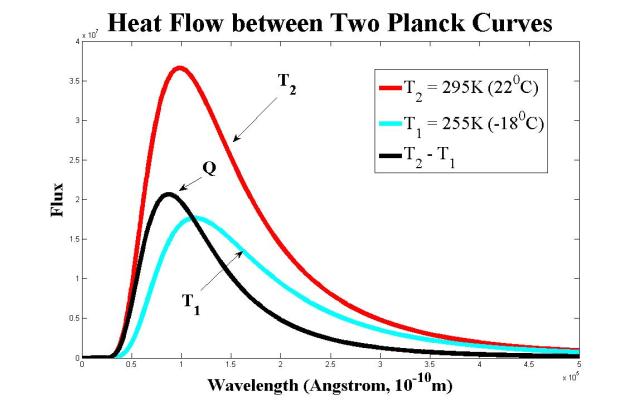
Please check my understanding of this graph:
The curve Q is T2-T1 – that is difference in temperature.
The point at which curve Q falls below curve T1 (the longer wavelengths) is the point at which frequency dependent heat flow stops.
If I have got this right this graph is the slam-dunk refutation of the idea that a low frequency source can impart heat to a hot substance.
Compelled? Maxwell’s Demon is working overtime!
Answering myself.
Where T2 – T1 = 0 then Q = 0
The graph shows that Q is positive at all frequencies where T2 > T1
My bad.
Thats exactly as I see matters Philip, once resonance ceases there can be no energy transferred.
This nulls the carbon footprint, I first picked this up from the Penn Uni trying to demonstrate the reverse. The Quote I use is , “Over 350ppm of dry CO2 no measurable heating was detected.”
A Demonstration of the Infrared Activity of Carbon Dioxide
Philip G. Sieg, William Berner, Peter K. Harnish, and Philip C. Nelson, Physics and Astronomy, University of Pennsylvania Philadelphia PA 19104
September 2, 2018
@CD: “Radiation is quantized into photons whose energy is proportional to frequency: E=hv.”
Exactly. Energy is digital, not analog. Not sure that helps…lol.
But in any case, the frequency components of photons is, like…the biggest deal. It’s why there is a photoelectric effect, for example. Below a certain frequency, NO MATTER HOW INTENSE THE LIGHT, the photons cannot eject electrons from a metal surface. But above a certain frequency, no matter how weak the intensity, the photons WILL eject electrons from a metal surface.
So you have two factors about photons: the intensity, or i.e., the total number of them together in unit time, and then, the frequency of each. It is their frequency, not the total number of them per unit time, which drives which physics can occur!
CD: “Surface= KE↑/PE↓
TOA=PE↑/KE↓
What changed from surface to TOA? The energy or the flux?”
That’s excellent. Nice and simple.
Thanks Joe,
the atmosphere is where they muddle the electron sophistry. I believe Kooks mentioned something about the equipartition of energy has nothing to do with the bound electron in a gas.
Molecular physicists seem to think that any vibrational increase automatically equals thermodynamic heat. I think that’s a big problem that they separate the macro from the micro and think that both are not co-dependent on a ty pe of “function”.
Philip Mulholland
That’s a good graph, so simple a climate clown activist posing as a scientist should get it.
I’m trolling that on Twitter,
Let the climate theatrics begin.
Anything in a lab can be manipulated doesn’t mean it exists in “real world applications”.
They have coerced bosons and fermions to imitate each other at very low levels.
This “chart” doesn’t look accurate, anyone.?
And this one?
Looks reasonable, doesn’t it?
Fired from work today (UofC) due to my books. EDI considered them harassment. 🤔 Hah.
By rights I either should have quit or been fired many years ago…lol. I should have quit, such as to not support the very machine I identified as being the main vector of evil on this planet.
Sorry to hear it.
Harassment to what exactly? Can you sue (if that’s even a thing in Canada anymore).
Honestly, I’m surprised you lasted this long especially in any Uni.
You are better suited for a space program anyway.
I hope you had a backup plan. I’m guessing you did.
How’s is the wife taking it?
JP that’s no bloody good. The parasites must have been racking their brains for years to come up with that justification.
Fired for being an academic? That’s got to be a first.
Very Sorry to hear your news Jo…… However, it’s clear confirmation that you are definately onto the climate scam….. They are obviously trying to silence you….. Stay strong we all support you but keep the message flowing…… Eventually you will be the hero I know that you are…… Kind Regards
Lots of Canadian science based on fighting the scam too bad most is controlled by the opposition. Seems like Spence has his hands in everything.
Joe, I’m truly sorry to hear of your work situation and fully appreciate that you’ve now got more pressing matters to attend to for both you and your family, so I’m not expecting any response to my thoughts below about what you said, in the very near future.
I said “But Joe, photons do not convey temperature, they convey only energy in the form of electromagnetic radiation.” And you responded “Photons convey energy flux density, which is why they relate to temperature through F = sigma*T^4. The flux of photons definitely does convey temperature”.
Whilst I agree that entire spectrum of the photons’ wavelengths comprising the energy flux density can be used to determine the surface temperature of the blackbody which is emitting this electromagnetic energy, the individual photons that are actually conveying all of that electromagnetic energy do not convey any temperature signature. Take an individual photon, say it has a wavelength of 1 Angstrom: from your diagram showing heat flow between two Plank curves (which I entirely agree with), it is not possible to determine whether that individual photon of 1 Angstrom was emitted by a blackbody surface at 295K or 255K. As you can see, the blackbody at 295K is emitting individual photons each having a wavelength between 0.4 Angstrom and 10 Angstrom, so how does a blackbody surface, say at 295K, determine that it is not allowed to thermalize the energy conveyed by an individual photon with a wavelength of 1 Angstrom when it was emitted from a surface at 255K yet it is allowed to thermalize the energy from a photon with a wavelength of 1 Angstrom if it originated from a blackbody surface at 350K? The truth of the matter is that a receiving surface can not, and does not perform any such discrimination. The real answer is clearly shown in that same diagram of heat flow between two Plank curves i.e. ALL of the electromagnetic energy from ALL of the photons from ALL of the wavelengths emitted by the surface at 255K are thermalized by the blackbody surface at 295K and ALL of the electromagnetic energy from ALL of the photons from ALL of the wavelengths emitted by the surface at 295K are thermalized by the blackbody surface at 255K. The difference in flux energy density, represented as Q, shows that more energy flows from the 295K surface to the 255K surface than the energy flowing from the 255K surface to the 295K surface. Hence it is true that ‘heat’ flows from the hotter object to the colder object but it is also true that radiative energy flows in both directions – it’s just that there’s more energy flux density flowing in the direction from hot surface to cold surface.
I said that “All of that energy is thermalized upon the blackbody surface,” and you responded by saying “That is only true while the energy flux density (temperature) at the surface of the receiving body is less than that of the incoming photons and their flux density as they arrive at said surface, which allows for the action of heat, and thus temperature increase. Otherwise, when the flux density at the surface of the body, and that of the incoming photons, are equal, then heat cannot act and hence temperature can no longer be increased. All photons do not automatically cause “thermalization” and temperature increase – only the higher frequency photons can do that.
This is not true, and even your diagram of heat flow between two Plank curves shows that Q comprises all of those same wavelengths that are being emitted by the surfaces at 255K and 295K. By your argument only those photons at the 4 Angstrom wavelength that are emitted by the 295K surface (and none are emitted by the 255K surface) can be absorbed by the 255K surface.
I said “irrespective of the temperature of the surface which originally emitted that photon or the temperature of the surface which the photon strikes.” And you responded by saying “Heat flow is definitely respective of the temperature of the receiving surface, which is a measure of its energy flux density, and the flux density of the incoming photons”.
I agree that heat flow (being the difference between emitted energy flux density and received energy flux density) is definitely respective of the temperature of both surfaces. However, energy flux density is most certainly flowing in BOTH directions.
I said “The individual photon does not carry any temperature signature of the originating surface temperature” and you responded “Absolutely it does! Photons carry frequency! Only higher frequency above that which is present can cause temperature increase”. This is not true, as discussed above.
You say that “All photons do not automatically cause ‘thermalization’ and temperature increase – only the higher frequency photons can do that”.
Photons emitted by different surfaces do not contend with each other. Only the temperature of the emitting blackbody surface can influence the amount of energy flux density and the range of wavelengths which these individual photons may have. That is true at both the hotter surface, colder surface or equilibrium temperature surface. Once emitted, ALL the photons will be thermalized upon the receiving surface – there’s no place else for them to go. You might say that some photons “just vibrate their way” into the receiving surface without being thermalized – but what about the energy that was being conveyed by that photon? However small, that electromagnetic energy can not be discarded or ignored. It’s not reflected, it’s absorbed such that the electromagnetic energy now manifests as kinetic energy i.e. it’s thermalized upon the receiving surface.
You said “Does an ice cube’s radiation make you hotter? Of course not! The discrimination is performed by frequency, and whether or not the receiving body already has that frequency, or not”.
There is NO discrimination based on frequency, it’s very much simpler than that. ALL of the energy from ALL the photons at ALL of the wavelengths being emitted from the ice walls at 273K will be absorbed by your body – it’s just that you (at 310K) will be emitting more energy flux density than you’ll be receiving from the ice wall. However, if the ice walls were at 150K, you’d be receiving even less energy flux density from the ice so you’d feel even colder, as the difference between sigma 310K^4 and Sigma 150K^4 is greater than the difference between sigma 310K^4 and Sigma 273^4. It is in this respect that ice at 273K actually DOES provide more relief to you than the ice at 150K.
I said “– all energy, no matter how small or large, within that and all other photons is thermalized upon the receiving surface.” And you responded “That is not what the heat equations for blackbodies say. An ice cube’s radiation does not make you warmer”.
Actually, if you look properly, the heat equation does say that the energy goes both ways and goes on to say that it’s the difference in magnitude of the energy flow in each direction that determines the direction of heat flow (which always from warmer to colder).
I said “Heat is transferred from the hotter surface to the colder surface only because there is more electromagnetic radiation emitted from the hotter surface than the electromagnetic radiation which is emitted from the colder surface.” And you responded “It is not merely that it is more, it is that the hotter body has higher frequencies that the cooler body does not.
Yes, the hotter surface does indeed emit some photons that have a higher frequency than any photon emitted by the colder surface. However, the hotter surface also emits more photons of frequencies that are also emitted by the colder surface and these photons also thermalize upon the colder surface (and thermalise upon the hotter surface).
I said “In a vacuum, both blackbody surfaces are compelled to emit according to their respective S-B temperature and both blackbody surfaces are compelled to absorb all of the electromagnetic energy that the received photons convey to it.” And you responded “That’s a word-game the alarmists like to use – attempting to force that ALL photons must cause heating for a blackbody”.
Honestly, I’m not trying to use word games here. I’m merely trying to exclude any scenario where the receiving surface might have a legitimate reason reflect any photon rather than absorb it.
I said “If both surfaces in the system reach equilibrium i.e. are at the same temperature, the amount of energy emitted from both surfaces is exactly the same as the energy absorbed (and thermalized) by both surfaces.” You responded “That is thermal equilibrium, yes…although, there is no more ‘thermalization’ per-se, since the temperature is constant”.
No, I don’t agree. In the state of thermal equilibrium thermalisation continues to occur however that amount of thermalisation exactly matches the cooling effect that would otherwise have occurred by the emissions at that surface.
I said “The point being that although heat transfer is, in this instance, zero the actual radiative energy transfer continues across both surfaces in both directions, unabated.” You responded “Well, heat transfer is zero in this case. The concepts from my previous videos on ontological mathematics applies. There is no distance or time for photons, so they “see” that there is nowhere for them to be absorbed when they are created”.
No I don‘t agree. Are you really suggesting that a photon with a wavelength of 4 Angstroms emitted by the furthest star in our galaxy will simply decay just above the surface of that star because the photon “sees” that it will collide with an object on this Earth that has a temperature say of 310K? No, I’m not buying it. All photons that are created must convey their respective energy packet to the destination surface and if that destination surface is a blackbody then it will always thermalize upon that receiving surface.
ST: “it is not possible to determine whether that individual photon of 1 Angstrom was emitted by a blackbody surface at 295K or 255K.”
While that is true, heat transfer is not limited to single photons, and, thermal emission is spontaneous. If the surface is emitting 1A photons at a slower rate than coming in, then the ones coming in will warm the surface; but they only warm the surface until the time at which the rate of surface emission of 1A photons is equal to that coming in. Photons are bosons and so the ones still coming in do not “press” against the ones being emitted such as to force the surface to become hotter – all you can get is an equality between incoming and outgoing. And so, the dependence is on frequency, and on the net rate of exchange at a given frequency – a hotter body has more photons at any given frequency, and the ones coming in cannot add more because they do not have the power which comes from higher frequencies.
I think that should answer the rest.
And also, finally, it is best to use the math, not the word-based analyses. If you wish to convert it into words, then the words have to explain the math – not the math be made to fit the words.
The First Law, i.e., how to increase temperature, is dU = Q = mCpdT
To get +dT, you need Q.
To get Q, you need Thot – Tcool, i.e., a warmer source, which means, higher frequencies, and more photons over all frequencies.
The human mind and human intuition and experience is largely fermion-based, and so it is difficult for us to think of bosons. The money analogies are fermionic. But photons are bosons and they behave differently.
These are the equations you have to work with:
dU = Q = mCpdT
Q = sigma*(Thot^4 – Tcool^4)
That’s it. Make your words explain those. One especially should not use words with no math which connects back to the fundamental definitions.