
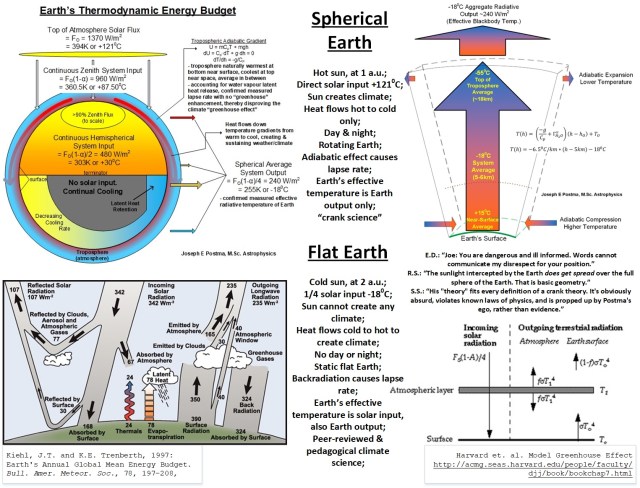
In this video I demonstrate that despite whatever ambiguous argument advocates wish to use to explain the radiative greenhouse mechanism, they all have the same effect, which is to cause a temperature gradient with altitude in the atmosphere. However, the value of the lapse rate can be calculated independently, and precisely, via adiabatic physics alone, which therefore indicates that there is no empirical room available for any further temperature-modulating effects from a radiative greenhouse effect. This is especially pertinent given that the derivation of the radiative greenhouse mechanism claims that it should be entirely responsible for the temperature lapse rate, but is then found to not have any contribution at all. Of course, the radiative greenhouse mechanism does not have any contribution because it does not exist, because it is a concept founded upon pseudoscientific non-ontological mathematical premises.
Support:
BTC: 1EeURvMjtGUxznP44cM6iSdDAqzjNUJFr8
PayPal: https://www.paypal.com/paypalme/joepostma
GiveSendGo: https://www.givesendgo.com/ontologicalmathematics
 Climate of Sophistry
I have been looking at your equation for establishing the Environmental or Wet Adiabatic Lapse Rate (WALR) from the Dry Adiabatic Lapse Rate (DALR) via the release of Latent Heat. There are many variables in play here but the most interesting question is why does the global WALR apparently have a constant value set at -6.5K/km? This modern value is different from the value of -6.0K/km used by GC Simpson in his 1928 paper Some Studies in Terrestrial Radiation, however the following statement made in 1928 still applies:
One of the outstanding results of the investigation of the upper atmosphere is that the mean lapse rate within the troposphere is practically the same in all parts of the world.
You address this in slide 7 where you derive an Environmental Lapse rate of 6.24 K/km from first principles by incorporating Latent Heat release into the process of potential energy formation by air mass rise during convection. So what is the limit of this process?
One thing that I am certain of is that because the lowest temperature for super cooled water droplets is -48.3o C, once that temperature is achieved via convection then no further release of Latent Heat is possible, so the top out temperature of latent heat assisted convection is -48.3o C and this temperature can be applied as an upper-level datum. So, working up via the WALR from a surface temperature of the global average value of 15oC then this temperature of -48.3o C happens at a top out convection upper-level height of 9,470m for a 1.49% water content using a constant WALR of -6.5 K/km.
Now here is the interesting bit, if we descend from 9,470m via the Dry Air Adiabatic Lapse Rate (DALR) of -9.74 K/km then the surface air temperature is 46.6oC. This value is interestingly similar to the modelled global average temperature of 42oC used by K&T 1997, an analysis which reported we here in Table 4 Key Energy Budget Metrics [2].
https://www.researchgate.net/publication/344539740_An_Analysis_of_the_Earth's_Energy_Budget
In their work K&T 1997 (Figure 7) applied Latent Heat surface cooling losses of 78 W/m2 as the dominant cooling process in the Earth’s climate. Using the equation for Latent Heat release to generate the WALR the global average surface air temperature relates directly to the freezing point of super cooled water. The real question once again is why -6.5 K/km for the global average Environmental Lapse Rate?
So what about the “Back Radiation causes surface heating” fiction? What physical atmospheric process can deliver heat back to the surface?
Answer: The process of adiabatic auto-compression, whereby descending dry air heats at the Dry Adiabatic Lapse Rate (DALR). The radiative physics concept of “Back Radiation” is in fact the returning limb of the meteorological process of mass-motion adiabatic convection in disguise.
When all that you have is a hammer (Radiative Physics) then everything is a nail.
Another argument pillar mainstream climate science uses is that the surface is in equilibrium with the 2 meter above atmosphere gas layer
While both components always seek equilibrium it mostly never is.
during a sunny day a street is much hotter than the 2 meter gas above it, reaching equilibrium somewhere at night
The surface is never globally temperature measured, and never could with the classic method. Can’t stick a thermometer in concrete
It is just assumed to be an average equilibrium
And by that conclusion assumed to be the same average temperature
A paradox deriving from that is. How can there be net heat release from the surface to the atmosphere if the average temperature of the first 2 meter is the same
If the Earth’s atmosphere were to comprise a mixture of only monatomic gases, would the global average near surface temperature be different to that provided by Earth’s existing atmosphere (which includes LWIR-active gases?
What would a new Earth’s global mean near-surface air temperature be if the new (barren) Earth’s atmosphere comprised only monatomic gas in the ratio 52% Neon and 48% Argon (the ratio selected to ensure the same total mass and the same number of molecules with a molar mass of 29g/mol being the same as Earth’s existing atmosphere’s molar mass)?
In place of the oceans, seas, lakes etc there’s levelled gravel. Above the ‘sea level’ (now the Gravel level) Mountains and hills correspond to the original Earth’s topology.
Gravity on new Earth is the same as original Earth. The absence of GHG gasses means there’s no water vapour and therefore no clouds (so no surface water either). Assume that the new Earth’s global average albedo (that can not now include clouds or snow/ice etc. so is fulfilled only by land) and the global average surface absorbtivity and emissivity remains at the original Earth’s present values. The Neon and Argon molecules always remain thoroughly mixed throughout the entire atmosphere. Geothermal energy is the same as orinal Earth (though gas emissions are zero). Finally, above the tropopause, ozone exists at the same quantities as the original Earth to absorb the ultra-violet and x-rays and gamma-rays to the same extent as they do today in the original Earth.
If the amount of energy externally provided to that new atmosphere was sufficient to achieve a global average air pressure at ‘gravel-level’ (former sea level) of 101.325kPa (corresponding to original Earth’s average sea level pressure), the new global average near surface temperature would be expected to be 288K. But after that initialisation, the new atmosphere would only receive it’s energy from the surface of the new Earth, by convection (conduction and advection).
Would the new atmosphere thereafter be provided with sufficient energy from the surface of the new Earth to maintain that pressure and hence temperature?
I genuinely don’t know (my intuition says that the lack of any radiative energy transfer into the new atmosphere should result in the new atmosphere receing less energy and so, gradually, a lower surface pressure will become established on the new Eartj and hence the global near surface temperature will be cooler than the original Earth (as any ‘excess’ kinetic energy within the new atmosphere would slowly be transferred back to the much colder night-side surface and subsequently radiated away from the surface into space) but perhaps I’m wrong. Instead, perhaps the increased day time surface temperature (due to the absence of evaporation) will increase the rate of conductive energy transfer from surface to the atmosphere thereby achieving the same atmospheric outcome i.e. maintained average surface pressure of 101.325kPa pressure (and consequently average near surface temperature of 288K) and thereby refuting the Radiative Greenhouse Gas Theory.
My expectations are that:
1. The absence of clouds would mean that the night time surface temperature would always get very cold before dawn (especially because there would be no dew to provide latent heat of condensation).
2. The daytime surface temperature would be hotter because (a) the GHG-free atmosphere wouldn’t intercept any incoming solar energy and (b) there would be no evaporation from the surface. Note that the absence of clouds would not make the surface warmer, as the new surface albedo has already been adjusted accordingly.
3. The Dry (unsaturated) Adiabatic Lapse Rate will persist unabbated to the Tropopause (the saturated adiabatic lapse rate will not commence from the Lifting Condensation Level due to the absence of water vapour, hence no clouds).
4. The Lapse Rate will start from the surface (as the air molecules at the surface can only gain their kinetic energy from the hot day-side surface of the Earth) and advection will then carry this energy upwards such that the kinetic energy is gradually converted to gravitational potential energy the higher up each parcel of air is until a pressure of 0.1 Bar indicates that the tropopause has been reached. Even if the average air pressure on the new Earth does remain the same as the original Earth, the average height at which the tropopause above the new Earth is reached will be lower than above the original Earth due to the Cp of the Neon/Argon mix being only 0.78K.Kg^-1.Km^-1 (leading to an adiabatic lapse rate of -12.5K.Km^-1). However, if the average near surface pressure does reduce from that of the original Earth, then the tropopause will be even lower.
I do not believe that, of itself, the existance of a Lapse Rate refutes the Radiative Green House Gas theory. A Lapse Rate wil exist on all plentary bodies with a surface pressure greater than 0.1Bar. That said, if the amout of kinetic supplied to the new atmosphere by conduction/advection alone is insufficient to establish a pressure of 10kPa then a lapse rate will not manifest itself (and even if the pressure within the new atmosphere is greater than 10kPa but less than 100KPa (285K) we really should be appreciative of the presence of all the LWIR-active molecules within our atmosphere).
I like this but due to the current ignorance in climate education you have to go further into explaining why we have variable temperatures and why sometimes the Earth “warms” and “cools”.
As the AGW argument is that the Sun is a constant (like that means anything intelligent) what is causing the warming? Which this is where climate science and climate politics varies.
The Claim:
The troposphere is warming and the stratosphere cooling exactly as predicted by AGW.
The real answer is more complex than this, but the simple physics is how much insolation reaches the surface factors in temperature. Short term, mid-term and long-term variation influence the overall climate. In the long term you cannot discard oceans as a driver. A very intense Sun a hundred years ago could still have current ramifications in current climate variability.
Ned Nikolov formalized this here: https://vimeo.com/602819278
paper: https://www.omicsonline.org/open-access/new-insights-on-the-physical-nature-of-the-atmospheric-greenhouse-effect-deduced-from-an-empirical-planetary-temperature-model.php?aid=88574
I’m struggling with the arithmetic of correcting the dry lapse rate to the close to actual LR using the latent heat of water vaporization (blushing in embarrassment). Can someone give me more of a hint? How to get from KJ/Kg to K/m?
@Claudiu
Nikolov seems to ignore the fact that radiation from the atmosphere is not energetic enough to warm the surface as it originally came from the surface. That would be kind of like standing in front of a mirror trying to warm yourself with your own radiation and as Joe points out, heat cannot be trapped as it is an action not a thing. I think his whole video has been debunked and is invalid.
@Alex Janssen
Correct me if I’m wrong, but I have not seen Nikolov making the claim that IR backradiates. Rather it is the atmospheric pressure that focus higher temperature closer to the surface. This doesn’t contradict Postmas idea of the atmospheric system temperature being -18 degrees at 0,5 atm pressure as far as I can conclude.
Agree
I come across this objection quite frequently. That millions of people would have to be involved in a conspiracy to say that CO2 at the level it was 100 years ago is responsible for our comfortable environment and any deviation from that is going to make us cook. Therefore it is not possible that we as humans can survive. I think you are right Joe; there is not much hope that humanity will survive this. I have seen those beings who are parasitical in nature. They attach themselves to us via our passions, desires, our lower urges. To quote Goethe: The little man knows it not ere the devil has him by the throat. Those same beings are also essential to life. In the right relationship to us they provide nurture. Our task here is to not only make sense of the world but to imbue it with love. Think of how you might behave in relation to your children. That is the preparatory school of love. How would you like to be treated as a child? Imagine you could be there as a parent of yourself. What would you do? The answer is obvious, but that answer needs to be extended across the whole of humanity and the whole of living beings and even the dead matter we assume is inert.
Well said.