
I have written about the steel greenhouse multiple times, as it has been such a gift for analysis and subsequent debunking of the back radiation concept of the radiative greenhouse effect. We saw such amazing things as the numerical value of the flux being conserved on the exterior of the shell, and when pointed out that this violates conservation of energy, the retort that it is permissible to violate the law of conservation of energy for the purpose of demonstrating the radiative greenhouse effect. Amazing!
Also note how interesting it is that this model gets abandoned and replaced with “setting the emission height” when it is pointed out that the adiabatic effect already explains the temperature gradient which the radiative greenhouse effect indicates that it should create; the adiabatic effect also explains the altitude of the expected average temperature, necessitating that the bottom of a gradient be the warmest part of the gradient, the top of the gradient the coolest, and therefore any expected average must occur around the middle. Of course, the average temperature structure is entirely explained by these means. Pick up Introduction to the Climate if you haven’t yet.
In any case, I used AI to run some numerical simulations of the sphere and shell scenario, with either a powered sphere and passive shell, but also with a passive sphere and powered shell just for fun, which helps highlight some basic physics logic. They all use the same scenario:
- A sphere of radius 1.00 m producing P = 2953 W internally. That is 235 W/m² over its surface, the same representative number as before, giving it a temperature of 253.7 K when alone.
- A steel shell from 1.50 m to 1.52 m radius (2 cm thick), with steel’s density, heat capacity and conductivity.
- Vacuum between them, black surfaces, and space at 0 K.
I’ve always wanted to create these simulations, they’re just a pain to code by hand…for free. Now with AI I can tell it what to do, look at the code and confirm it’s doing what it is supposed to, et voilà.
The Heat-Flow Model
This follows directly from the math in this article, just extended to partial differential equations instead of final steady state equilibrium solutions. That is, the sphere produces the power, it has a constant emission and therefore temperature initially, and then a shell is brought in at 0 K. What can happen then? That’s the question – what happens then?
Well what happens in thermodynamic theory is that we have to consider the action of heat. Note that I avoided saying “heat flow” or “heat transfer” as these are actually antiquated terms which suggest that heat is a substance which flows or transfers – this is inaccurate. Considering the First Law of Thermodynamics, dU = Q + W, which says that the internal energy (U) of a body changes (dU) via heat (Q) or work (W), then given that Q & W are commensurate physical processes such that they add directly together without distinguishment, so just as work is an action from one body upon another, then likewise heat is an action from one body upon another. Heat and work are the action which change internal thermal energy, and thus temperature, given the full 1st Law equation dU = Q + W = mCpdT. That is, to get a change in temperature dT, you need a dU, which comes from Q and W.
Work occurs via mechanical force, whereas heat occurs via the “thermal force” of the hot body’s energy increasing the colder body’s energy, which only occurs in that hot to cold direction. The hotter body has energy microstates, or energy frequencies, which the colder body lacks; the higher frequency, and more plentiful across all frequency, energy of the warmer body are imposed upon the cooler body and do work at the microstate level of the cooler body and thereby increases the cooler body’s internal thermal energy and hence its temperature. This process does not happen in reverse because the cooler body does not have the “force” of higher frequency microstates it would require to induce even higher frequency microstates in the warmer body in order to raise its temperature.
Thus, what happens is that heat acts from the sphere on the interior of the shell. The sphere has a temperature and is “hot”, the shell has no temperature and is cold. So the sphere will heat the shell. And then what? What happens when the shell attains a temperature? What can happen then?
The radiative greenhouse effect postulates that the thermal radiation which now starts to emit from the interior of the shell will have to be absorbed by the sphere and raise the sphere’s temperature. And that obviously contradicts what we just discussed about how heat works and what it does. No one denies that the interior of the shell will emit thermal radiation; what has never been established is by what mechanism that emission can increase the temperature of the warmer sphere? In thermodynamics we only have heat or work to do that – to raise temperature. Work is not available. And likewise, there is no heat available from the shell either, given what we know about how heat works and its equations – there is no positive heat from the shell on the sphere in this scenario because the shell is always cooler than the sphere.
So then with nothing else to do, we just compute it. We compute the heat in the direction that it can act, from the sphere to the shell, and we watch what happens to the shell. The sphere cannot increase in temperature because it never gets any heat.
Inside the shell material the temperature obeys the radial heat-conduction equation:
ρ c ∂T/∂t = (1/r2) ∂/∂r(k r2 ∂T/∂r), rin < r < rout
On the inner face, the shell absorbs the flux from the sphere, which has been reduced by the inverse-square law:
−k ∂T/∂r (at rin) = σ Tsp4 (rsp/rin)2
On the outer face, the shell radiates to space:
−k ∂T/∂r (at rout) = σ Tsh4
And the heat flow at the shell is the same equation I wrote down in 2013:
Qsh = Ash σ[Tsp4(rsp/rsh)2 − Tsh4]
When Q is positive, heat flows into the shell and the shell rises in temperature. When the shell reaches equilibrium, Q = 0 and
Tsh = Tsp(rsp/rsh)1/2 = 205.8 K
So what happens when we run it? At the start the shell is at 0 K and Q = +2953 W, sphere to shell. At 73.1 hours the shell is at 203.7 K, within 1% of its equilibrium of 205.8 K, and Q has fallen to +116 W, which is close enough to zero to stop. We could keep waiting for the asymptote, but I didn’t, because the result is visible.
Now look at the energy balance. At 73.1 hours the shell emits 2837 W to space and stores the last 116 W as it finishes warming: 2837 + 116 = 2953 W. In the long run it emits exactly 2953 W, the sphere’s power, from its larger surface at its lower temperature. Energy is conserved. Flux is not conserved, and it can’t be, because the area is larger.
That’s it. The sphere heats the shell, the shell comes to the temperature that the sphere’s flux at its distance supports, and the shell passes the sphere’s power out through its exterior.
Heat is required to increase the temperature of a body, and the cooler shell has no heat for the warmer sphere. There is inward radiation from the shell, but it cannot act as heat for the warmer sphere. Heat only comes from warmer bodies, and heat is required to increase a body’s temperature, and the shell is cooler than the sphere and so therefore cannot heat the sphere. Only the sphere heats the shell. The interior radiation of the shell cannot do anything to the warmer sphere. None of this is my hypothesis, but is simply a statement from thermodynamic theory. I did not hypothesize this or create it, it is simply a recitation of standard thermodynamics.
Back Radiation into the Sphere
Of course, the radiative greenhouse back radiation advocates then have to postulate a different mechanism than heat, non-mathematically defined in nature in thermodynamics, but the claim usually involves the slogan of “slowed emission” or “slowed cooling”, and requires that the interior emission from the shell has the same effect as if it was heat into the sphere, although they acknowledge that it cannot be called heat, so they call it “causing slowed emission from the sphere” instead.
That slogan is of course entirely outside of the concepts of heat, work, and the First Law of Thermodynamics, and the equation required to model that slogan is entirely the same thing as what a reverse heat-flow term would look like. So it has all of the mathematical elements of just calling it additional heat from the cooler shell, but they don’t call it heat because it cannot be called heat.
Thus, the shell’s interior emission which creates a uniform sky background with respect to the sphere is added to the sphere, providing an additional input to the sphere of Asp σ Tin4 so that
Csp dTsp/dt = Pint + Asp σ Tin4 − Asp σ Tsp4
Without the shell term, when dTsp/dt → 0 in equilibrium, you just get the original sphere equation for its power and temperature Pint = Asp σ Tsp4. But so, we add the amount of radiation from the shell that the sphere would collect, which is the sphere’s area times the uniform sky flux of the shell, which is the Asp σ Tin4 term.
This seems so reasonable. “There is energy from the shell so it must be added to the sphere because of energy conservation.” However, doing so ignores the rest of the laws of thermodynamics, and in fact does not actually use the First Law. It reads as if it is using the First Law in the context of “conservation of energy”, i.e., if energy is conserved, then you have to add it everywhere, to keep track of it and keep it all summed up in total, correct?
But that is not what the First Law actually says and how it defines that energy is conserved. Energy is conserved in the First Law by dU = Q + W = mCpdT, as discussed in the previous section with all caveats still applying for the meaning of heat Q and work W. Those caveats informed that energy does not simply add directly and fully in from another object, but only the difference of energy can do so, with the positive side of the difference from the warmer body adding to the body with lower temperature.
Consider also what the shell’s power Asp σ Tin4 is in terms of where it came from, and what its nature is compared to where it came from: that energy came originally from the sphere, and now it adds back in to the sphere as a second independent input, and fully-so, despite it having a lower frequency microstate from the cooler shell. We must dispense with the entire scheme of comparing bodies’ flux, temperature, and frequencies, with respect to how that establishes heat between bodies, and simply fully add the entire component of the cooler body’s lower flux, less-populated frequency microstates, and lower frequencies, into the generating hotter body as a full second input. This simply does not follow the laws of thermodynamics, but it sounds like it does when all that is claimed is “conservation of energy.” Joules which left the originating and heating body are returning as lower frequency lower energy joules and are doing the same thing as heat from a hotter source would be able to do, but without calling them heat.
Of course in In the Cold Light of Day I demonstrated that this leads to a mathematical contradiction where 1 = 2, which may also be posted somewhere on this site.
We do get conservation of energy to the outside of the system in this scheme and that can make it look legitimate, but what happened on the inside was a very confusing and ill-defined or even non-defined mess of slogan claims which do not sit cleanly as the first section with its simple heat flow treatment consistent with thermodynamics.
One thing stands out in the above simulation, though. Look at the plot for the heat from the sphere to the shell: it ends up being conserved, and equal to the power from the sphere. This is why it is always said that “heat is not a conserved quantity.”
But more importantly, heat is not power. Power is energy. Heat is an action like work, and just like work, it cannot act on space. There is no work W which can be performed on space because work is performed on physical material objects, and space is not a physical material object. Just the same, heat cannot be performed on space because space cannot attain a temperature because space is not physical matter. There is no heat transfer possible to space, so an equation which requires a statement that heat transfers to space is incorrect.
Mutual Exclusivity
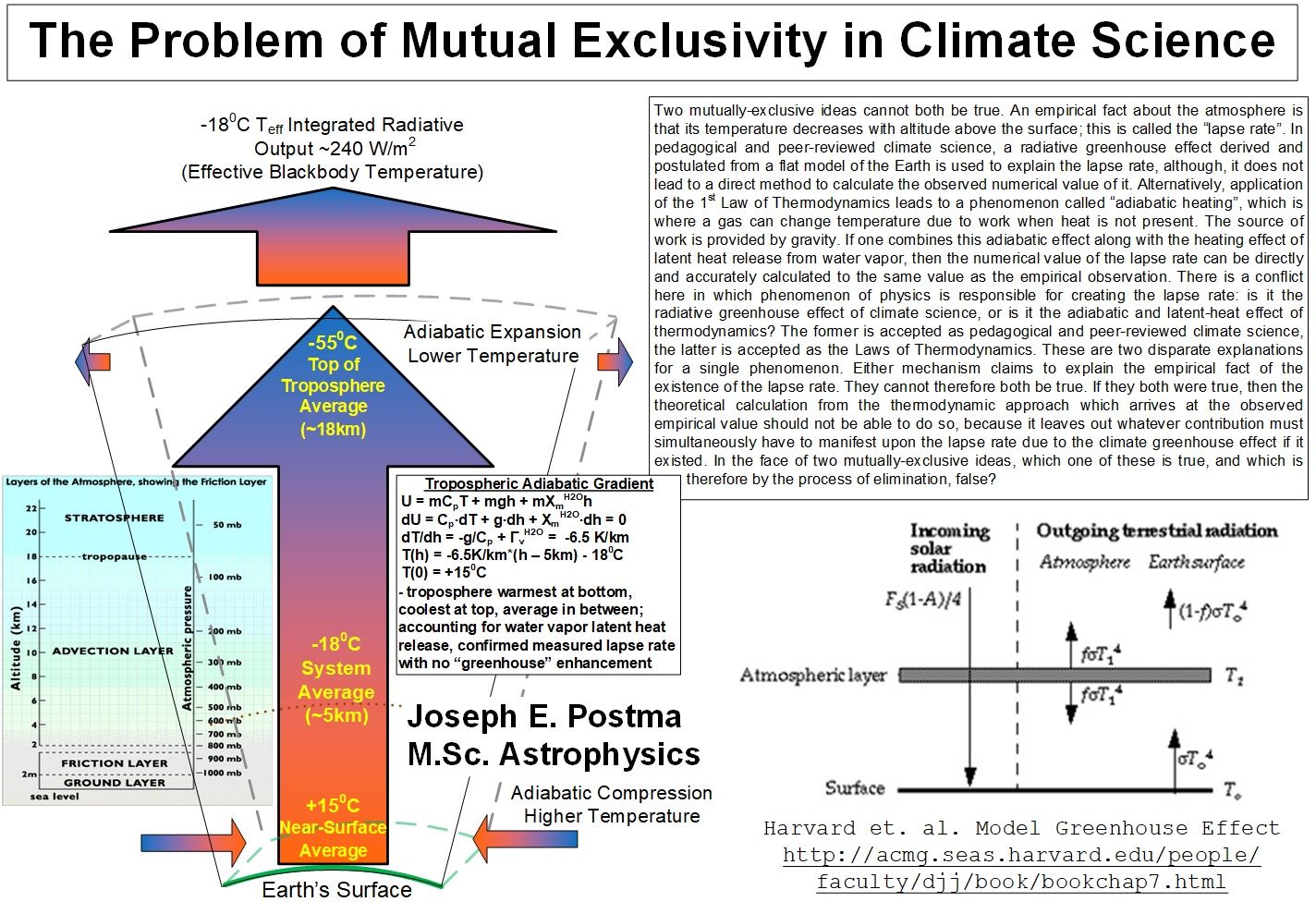
Consider what has been done with the backradiation scheme when it is applied to the atmosphere: it implies nothing other than that a temperature gradient must be created by this back-radiative exchange because it makes the bottom of the troposphere be hotter than the upper troposphere. The back radiation greenhouse effect, whether calling it heating or not, results in a claim of responsibility for the vertical temperature lapse of the troposphere.
Just as the flat Earth slab models leave out any reference to gas thermodynamics and the adiabatic effect, and stands in for those, likewise this steel greenhouse scheme transferred to the troposphere attempts the same stand-in.
Of course, the most amazing thing happens when the adiabatic effect is derived from first principles and is demonstrated to arrive precisely at the values of the empirical troposphere: Suddenly all of the effort which went in to explaining and defending and justifying the radiative greenhouse effect is dispensed with and forgotten about, and the radiative greenhouse effect is now about setting the emission height. Mutually-exclusive logic removes the previously claimed role of the radiative greenhouse effect, and so it then morphs into something entirely different than what it was before.
The claim of raised emission height comes with a claim of raised altitude of where -18°C is found, such that the adiabatic gradient then has more range to induce a higher surface temperature. However, this is nothing more than the conservation of flux error made by the steel greenhouse when it was first encountered, such that a constant flux via F = σT4 is placed on a larger shell surface area, thereby violating conservation of energy against a fixed input. This is of course why it was demanded that it is permissible to violate conservation of energy for the purpose of demonstrating the radiative greenhouse effect.
The Powered Shell
Just for fun, let’s invert the steel greenhouse and power the shell instead of the sphere. Give the shell the same 2953 W, spread through its material, and it sits at 205.8 K emitting that power to space. Its interior sees only itself, a uniform sky, and it can’t lose energy to itself. Now put a 0 K sphere inside. The shell is the hot body and the sphere is the cold one, so the shell heats the sphere: Q = Aspσ(Tin4 − Tsp4), acting from shell to sphere. The shell drops in temperature at first while it loses internal energy emissions into the thermal energy storage of the sphere. Then the sphere comes up to the temperature of the shell’s interior sky, Q goes to zero, and the shell is back to emitting 2953 W.
What’s interesting is that the back radiation advocates’ bookkeeping gives exactly the same answer here. Their net exchange between the shell’s interior and the sphere reduces to the very same heat equation, from hot to cold, going to zero. Nobody disagrees when the exterior powered body heats a colder passive interior body. That pins the steel greenhouse down to a single question: can the radiation from a cooler passive body raise the temperature of the warmer powered body it surrounds? Thermodynamics says that requires heat, heat only acts from hot to cold, and the shell is always cooler than the sphere. The back radiation scheme needs it to happen anyway, and has to call it something other than heat to get it in. That is the difference, and that is where it fails.


Just from a deductive standpoint, if the sphere lost some of its heat to the shell, any heat reradiated back to the sphere (were that possible) would only represent some of what the sphere had previously transferred, resulting in no net gain in temperature (and it would only return part of the heat if the rest goes out to space from the outer surface). Or am I missing some essential greenhouse voodoo?